Thursday, April 25, 2013

Stereotypes and the NBA


Shawn Kurian

America is a place that is lauded for its overall tolerance for people of all different cultures and ethnicities. But it is not always true. America was nicknamed “the melting pot” of the world. However, a melting pot includes in its description, a mixing and unifying of cultures; “melting all the cultures together into one. This has caused many to argue that America is instead a “salad bowl” where multiple cultures exist together in one form but remain distinct. As a general civilian of Chicago, I have seen the salad bowl much more clearly than the melting pot, because prejudices and stereotypes still keep some people from integrating fully. Most recently, NBA sensation Jeremy Lin called out this inequality that exists in an interview as a reason that prevented from entering the NBA earlier.

Jeremy Lin is a 24 year old, second year NBA player and starting

point guard for the Houston Rockets. Lin shot to fame after being picked up by the New York Knicks due to injuries to their other guards, and then performing phenomenally until injured late in the season. As a result, the Rockets signed him for a three year $25 million contract to play for them. But what further adds to Lin’s story is that he came undrafted out of Harvard, then played briefly for the Golden State Warriors and Rockets, but then returned to the NBA’s development league, where he was picked up by New York. Recently, Lin conducted an interview with ‘60 minutes’ and discussed how a race barrier in college prevented him from being drafted out of high school. Indeed, after being Palo Alto HIgh School’s basketball team’s captain as well as California’s player the year award. Yet, he was not picked by either UCLA, Stanford, nor Harvard for basketball.   


Lin’s ethnicity is part of why he was a sensation last season. Other than Yao Ming, there hadn’t been  a Asian NBA player that reached the national and even international spotlight. But upon reaching the spotlight, Lin reflects that being a white or black high schooler would have given him the chance to be drafted by a college. Though heavily underrated, the stereotypes and prejudices that keep of different cultures away from reaching their full potential is surprisingly large. And while Lin is living well now, imagine he could have been if he had played for college and was then drafted into the NBA.

So how do you become well-known even if stereotypes are held against you? Work hard, play hard, and you can get recognized for your work. The NBA is seeking to accept players from all over the world, especially American states, and as the premier basketball league seeks to a place for high and strong competition. Let us hope that the NBA continues to this with continued attention to giving all players a fair chance to come play.


Wednesday, April 24, 2013

Balance


One of the greatest things about our lives are the limitless opportunity that it presents— however, it also serves as the biggest dilemma. There are so many things to do, so many places to be, and so many people to be there and do them with. But, not nearly enough time to do them all— I mean you only have 24 hours in a day, 7 days in a week, and you gotta sleep. So what do you do? You play a balancing act.
And as a student that balancing act is perhaps the greatest of all, when you think about it, you’re “forced” to be somewhere from seven to three (i.e. school), not including extra curriculars and the time spent doing homework, and you have to somehow manage to fit everything in that you’ve chosen to do for yourself. We all know how it feels and it only gets worse after school— commitments get harder and more responsibility comes with the age. And balancing is all about priorities, people make more time for what they believe is important. Personally, I do believe that education and such is very significant, however, it’s obviously not everything. And there are a few opportunities one has to put graded education on the backburner and simply enjoy themselves. As a second semester senior, I can happily say that I’ve been blessed with one of those opportunities as I write, and I’m here to tell you why senioritis isn’t such a bad thing after all.

Senioritis contrary to popular belief isn’t so much the complete falling out of all educational desire, but it’s really just a reprioritization of a student’s personal pursuits. We’ve spent a large part of three and a half years devoting our time to grooming and maintaining this number called a grade point average (although I can’t speak for everybody), and finally, we get this semester to not have to focus on that silly number. And it’s honestly ridiculous to expect kids to not mentally take some time off— maybe the only time they’re ever going to have this ever again. Think about it, the second semester of college will matter because it affects the gpa that’ll be shown to future employers, and once you’re in the workforce, who knows how much time you’ll have off. This is the time to pick up that dusted guitar, to read that book without having to scribble your thoughts on every page, to simply enjoy yourself.
And it’s not to say that it’s okay to stop working, because it’s not— but maybe the next time you’re inside studying for that test on differential equations that probably won’t matter the day after you take it, go outside, gather the neighborhood gang on the sandlot or find a dog and teach it to play basketball. Cause life’s a balancing act, but the few times where you can really prioritize yourself, capitalize. 

Tuesday, April 2, 2013

Captain Kirk


Chicago went absolutely insane over their hometown Bulls last Wednesday, with a fervor that typically follows a championship game. And it wasn’t even the playoffs. All they did was add another W in the regular season’s column, but the loss that it meant for their opponents that night meant a heck of a lot more.
Last week the Bulls put an end to the Miami Heat’s 27 game win streak— they hadn’t lost a game since February 1st. And even if you don’t know basketball, that’s an incredible streak to maintain. For a third of an NBA season, they were flawless— making it the second longest winning streak in the history of the league. The first belonging to the 1972 Los Angeles Lakers, but in a league with a substantially smaller number of teams, and where teams didn’t play games nearly as close to one another. Which all make the Heat’s run significantly more impressive.

            So here’s the conundrum— that game didn’t technically mean that much to Chicago, so why did they celebrate like it did? And the answer is because the Heat are a better team and everybody knows it. Miami knows it, ESPN knows it, even Chicago knows it. There’s a level of understood inequality between the two teams, which makes the win by the underdog novel and exciting. And the phenomenon isn’t isolated to the world of sports. People love when the unexpected occurs— when an underdog pulls off an upset, when a David beats a Goliath, when inequality doesn’t win.

            Yes, inequality tips the scale in competition, but when the odds are upset we go ballistic. And it hits the core of the human experience— it’s a story about defiance and hope. We cling onto stories that show us that anything is possible, and that’s why, in some sense, we need inequality. To tell us that we can’t, so we can.

            For the bulls they won with scrappiness and heart, although talented they were clearly inferior on paper, and when Kirk Hinrich wrapped up Lebron James and took him down a drive, it epitomized what it means to defy inequality. You’re going to have to put in 110% and play your heart out if you’re going to pull it off.


Tuesday, February 26, 2013

Blade Killer


      Oscar Pistorius— famed Olympic athlete. Paralympic hero. Murderer.

I’m sure that if you have the capacity to access this relatively small blog, then you’ve probably read about the Blade Runner tragedy. He was arrested about a week ago on the account of the premeditated murder of his 29 year old girlfriend, Reeva Steenkamp, an aspiring model and actress. But as I went through the case, I couldn’t help but think, where’s the preferential treatment?
The justice system is supposed to be of equality and fair representation, especially in particularly developed systems like the American justice system and South Africa’s— yet we find individuals placed above it all the time (if you want to read about South Africa’s Justice System, follow this link, there are many differences in this case proceeding).

The example that you can’t miss: O.J Simpson. He was held on trial on account for the murder of his ex-wife Nicole Brown Simpson and her friend, Ronald Goldman— facing a potential death sentence. Yet, he was found not guilty in a case that seemed to have insurmountable evidence piled against him, including a pair of his socks with Nicole Brown’s blood spattered on them. Upon his acquittal he wrote a book titled “If I Did It”, outlining the steps he would’ve taken had he committed the murders. Celebrity won big in a place where fame has no place— the justice system.

       And there are a number of examples that follow the same storyline— Ray Lewis, the Baltimore Raven’s star was charged with double murder and walked. Leonard Little, a St. Louis Rams linebacker was actually convicted with the DUI-murder of Susan Gutweiler, because he rammed into her car after running a red light under the influence.  And it seems that Pistorius’s case might just be taking the same turn.


    Analysts and experts have taken a close look at the evidence and the stories, and although there is always room for debate, an ostensible glance at the forensics doesn’t bode well for Pistorius. New York City Attorney Tom Harvey said, looking just at the forensic evidence, that the guy is guilty as hell.” His story sounds pretty incredulous— that he shot her through a door because he feared it was an intruder that had come through an open window and locked them self in the bathroom (here’s more for a better understanding of his story). First, for someone who claims that they’re incredibly paranoid of neighborhood crime, why would the door be open? Second, how could you not know that your girlfriend was no longer in your bed next to you, the place that both sides stipulated she was moments before the murder? And third, why would he have any reason to believe that a thief would hide in a bathroom, and not even look to make sure it was his girlfriend? And whether you side with me or not, there’s clearly not enough evidence for him to put grant him the bail he just recently received.

            Ultimately, we can only hope that justice is served, whatever way that may be— but without a bias for the Olympic hero, or for that matter, although unforeseeable, against him. Although, as the proceedings look now, it seems that the special treatment world class athletes receive in the courtroom hasn’t lost its touch in South Africa. 


Monday, February 11, 2013

Sports, A Man's Game?


Athletic competition, a widely touted vanguard for equality— every individual can compete as long as they have the physical capacity to succeed. For many, it’s seen as the equalizer in societies. We’ve heard it a billion times; a talented kid grows up in an impoverished ghetto and eventually makes millions of dollars doing what he loves whether it be soccer, basketball, or baseball, you name a sport and this story has a place in it.
However, is this image of sports really as true to its appearance as it should be? Take race for instance. Racism is talked about as an artifact in so many sports— Jackie Robinson broke the color barrier in the MLB (Major League Baseball Association) nearly 60 years ago, and Jeremy Lin has infiltrated the NBA (National Basketball Association) for Asian Americans everywhere. But is it really gone? In perhaps, the most global sport of all— football, or as Americans refer to it, soccer, racism is a very real problem. Players are forced to walk-off of fields in the midst of competition due to the physical and verbal abuse they face on a daily basis (you can read more here). And sometimes racist sentiment in the sport leads to even more, recently resulting in an arson attack against recruited Arab players in Israel.

However, there exists an even greater gap of inequality for a different group of people. Today I want to focus on a bias towards roughly 50% of the world’s population: women. To begin, the amount of sports made available to women are just recently catching up to the number available to men. Professional parallel organizations like the WNBA and the WLS (Women’s League Soccer) weren't created until very recently— the WNBA in 1996 and the WLS in 2010. And believe it or not, but the 2012 was the first Olympics in which women were allowed to participate in every sport.
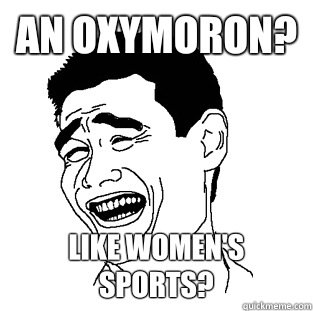
Past, the technical restrictions on women— the culture surrounding their competition is also unsettling. Women’s sports are often given a lack of credence and written off as a joke— it’s not uncommon to see a ton of remarks and posts in the same vein as this:


Furthermore, girls are dropping out of sports as they hit their teens at twice the rate of boys, and according to the Women’s Sport and Fitness Foundation, it’s because sports are perceived as unfeminine— an unfriendly misconception to further integration and equality of the realm of physical activity. Especially when physical dominance is a cornerstone of the machoistic male figure, this only leaves more room for divisions.

All in all, I guess it’s a question of how much we’re willing to change as a society— organizations are doing their part, creating women’s groups and professional leagues, but how accepted and popular they become is up to the culture they’re competing for. 

Tuesday, January 29, 2013

The Movie Festival


            When we’re presented with the concept of inequality our minds usually don’t arrive at Hollywood— perhaps, the most profitable film industry in the world with the likes of Universal Studios, Paramount Pictures, Disney and Miramax.  Raking in millions upon millions of dollars, some of the wealthiest individuals on this planet call Hollywood home, and the poor are all too few. But in the hyper competitive industry of film, not every film maker has the capital to throw 300 million dollars towards movie production like Disney did for Pirates of the Caribbean: At World’s End. The majority of directors and producers have to make do with significantly less, and still attempt to reach levels of success.

            With the upcoming Academy Awards, February 24th, and the recent showing at the Golden Globes and SAGS (Screen Actors Guild Awards), awards season has hit its stride. And although a few low(er) budget films have snagged awards, most notably, The Iron Lady at last year’s Globes for Meryl Streep’s performance as Margaret Thatcher, which cost just about 13 million dollars to produce in stark contrast to the winner of best picture this year: Argo, which was produced with a 45 million dollar budget. But it’s not the only one that cost massive amounts of money to create— most films at this level do, so how do “cheaper” films compete? And the answer is they don’t.

            Well not in the conventional sense anyway. Many producers and directors opt for alternative methods of showcasing their work— you probably won’t see most of these movies in your local theater, but you will see them at The Sundance Film Festival in Park City, Utah and The Cannes Film Festival of Cannes, France— two of the largest independent film festivals in the world. They’re famous for showcasing international films, documentaries and the beginnings of many incredible filmmakers who would’ve otherwise fallen into the depths of obscurity.

            Now film festivals are usually placed in small towns and cities, they’re a place where independent filmmakers can have their work judged by a number of professionals and prominent members of the film industry. A notable success is the movie Once, directed and written by filmmaker John Carney which cost less than 160,000 dollars to make, but ended up making just about 21 million— this movie, showcased at the Sundance Film Festival, and ultimately winning the Academy Award for Best Original Song and a nomination for a Grammy.


            Robert Duvall, famous actor most known for his role in The Godfather, once said that “Hollywood is still the mecca for good or bad, but it isn't the beginning or end for filmmaking.” And that’s certainly something to hold on to for many aspiring and independent filmmakers. 

Thursday, December 13, 2012

Lines

            From our artistic beginnings, we learned how to draw lines. Straight lines, crooked lines, black lines, white lines. And we still do— except today, we use them among people. We divide and group individuals in our mind, and even if we don’t overtly stereotype, we all hold certain assumptions and jump to conclusions about others based on certain characteristics like their race, dialect, appearance, etc.


Even men as great as George Clooney are offenders:


            And it’s more than that. The consequences of how we think about individuals, are far reaching— they determine how we act towards them and ultimately who they are relative to ourselves. And often times we don’t recognize this, but these thoughts ultimately end up as a self fulfilling prophecy.

Let’s look at an example:
Let’s say Timmy is a fourth grader and accidentally bumped into a fifth grader in the lunch line. Now Timmy thinks that this big bad fifth grader is going to retaliate because that’s what fifth graders do. So he turns around and gives the fifth grader a good taste of his fist to land the first hit, which obviously angers the older child who returns the favor, a punch he wouldn’t have thrown had Timmy not preempted a nonexistent fight.

Now, Timmy constructed the threat that this individual posed, based off of his assumption that retaliation would be inevitable, actually leading to what he feared. Now it sounds ridiculous, but it happens more often that you’d think. And on a global scale— countries do this too, and often the conflict involves more than a few scratches and bruises, they risk war.

Let’s think about the enemies that our country has. The first that comes to mind are terrorists— a threat that’s driven our nation to an economic quagmire and military overstretch. But are they really everything that we make them out to be, do they really meet the constructed image that we've portrayed them as?

Look at Iraq. We invaded to prevent the development and usage of Weapons of Mass Destruction by terrorist groups, which by the way we still haven’t found today. And our military presence has actually incited more opposition in the region. Christopher Layne, a national editor of the Atlantic, wrote in his study, “Middle East grand strategy after Iraq: the moment for offshore balancing has arrived” that

“The US presence on the ground in the Middle East also incites terrorists to attack American interests…‘what nearly all suicide terrorist attacks have in common is a…goal: to compel modern democracies to withdraw military forces from territory that the terrorists consider to be their homeland’
(It can be found here)

An even better example is the Cold war. Construction of threats is literally the reason that an arms race began. Our country made the Soviets an “other”, assuming that they would develop arms to harm the good people of the United States, in turn justifying their development of nuclear weapons, which just incited further justification for the Soviets to develop their weapons of which we pointed to and said we had to keep increasing our arsenal for. It’s a self fulfilling prophecy.

The moral of the story is, be careful how you think and how you group and “otherwise” different groups of people, because it’s not just a thought, it affects much, much, more.